Environmental Sciences - 2025
Complete Detailed Solutions · Previous Year Paper
Group A — Very Short Answer Type
1. (I) Define the term Environment.
Environment refers to the sum total of all physical, chemical, biological, and social factors that surround an organism or a population and influence its survival, growth, and development.
1. (II) What is noise pollution?
Noise pollution is the presence of excessive, unwanted, or disturbing sound in the environment that disrupts the normal activities, health, or quality of life of humans and animals.
1. (III) Give two example of renewable resource.
Two examples of renewable resources are Solar energy and Wind energy (other examples include timber, geothermal energy, and biomass).
1. (IV) Name the pollutant which is responsible for ozone depletion.
The primary pollutants responsible for ozone depletion are Chlorofluorocarbons (CFCs).
1. (V) What do you mean by Biotic component of ecosystem?
Biotic components are the living parts of an ecosystem, which include all plants (producers), animals (consumers), and microorganisms (decomposers) that interact with each other and their environment.
1. (VI) What is the percentage of oxygen present in the troposphere?
Oxygen makes up approximately 20.9% (or 21%) of the Earth's troposphere.
1. (VII) Define the term BOD.
BOD (Biochemical Oxygen Demand) is the amount of dissolved oxygen consumed by aerobic microorganisms to break down the organic matter present in a given water sample at a specific temperature over a specific time period (usually 5 days).
1. (VIII) What is the major element found in earth crust?
The most abundant element in the Earth's crust is Oxygen (making up about 46.6% by weight).
1. (IX) What is equivalent noise level?
Equivalent continuous noise level (Leq) is the constant noise level that would result in the same total sound energy being produced over a given period as a fluctuating noise level over that same period.
1. (X) Why environmental protection act was established?
The Environmental Protection Act (1986 in India) was established in the wake of the Bhopal Gas Tragedy to provide a unified framework for the protection and improvement of the environment, and to regulate hazardous substances and industrial pollution.
1. (XI) What do you mean by doubling time in exponential population growth?
Doubling time is the amount of time it takes for a given population to double in size, assuming its growth rate remains constant (calculated using the Rule of 70: Doubling Time = 70 / Growth Rate % ).
1. (XII) The term 'ecology' evolved from which Greek words?
The term ecology comes from the Greek words "oikos" (meaning house or dwelling) and "logos" (meaning study of), literally translating to the "study of the household (nature)."
Group B — Short Answer Type
2. Write a brief note about noise pollution.
Noise Pollution:
Noise pollution is defined as unwanted or excessive sound that can have deleterious effects on human health, wildlife, and environmental quality.
- Sources: It stems from transportation systems (road traffic, aircraft, trains), industrial machinery, construction activities, and social events (loudspeakers).
- Effects: Chronic exposure can lead to noise-induced hearing loss (NIHL), high blood pressure, heart disease, sleep disturbances, stress, and impaired cognitive development in children.
- Measurement: It is measured in decibels (dB), with prolonged exposure to levels above 85 dB considered harmful.
3. Write a short note about water pollution.
Water Pollution:
Water pollution is the contamination of water bodies (lakes, rivers, oceans, aquifers) due to human activities, making the water toxic to humans or the environment.
- Causes: The primary causes include the discharge of untreated industrial effluents containing heavy metals, domestic sewage, agricultural runoff carrying chemical fertilizers and pesticides, and accidental oil spills.
- Consequences: It destroys aquatic ecosystems, causes waterborne diseases (like cholera and typhoid) in humans, and triggers eutrophication (algal blooms that deplete dissolved oxygen).
- Control: Involves treating wastewater before discharge, minimizing chemical use in agriculture, and strictly enforcing effluent standards.
4. Write brief note about solid waste management and control.
Solid Waste Management:
This is the systematic process of collecting, treating, and disposing of solid material that is discarded because it has served its purpose or is no longer useful.
Key Steps & Control Measures:
- Waste Hierarchy (The 3 Rs): The most effective control is to Reduce waste at the source, Reuse items when possible, and Recycle materials like paper, glass, and plastic.
- Collection and Segregation: Separating waste at the source into biodegradable, recyclable, and hazardous categories.
- Treatment: Organic waste can be managed through composting or biomethanation.
- Disposal: Remaining waste should be disposed of in engineered sanitary landfills or incinerators equipped with emission controls.
5. Write a brief note about noise pollution control measurement.
Noise Pollution Control Measures:
Controlling noise pollution can be tackled at three levels:
- At the Source: Designing quieter machinery, regular maintenance and lubrication of moving parts, using silencers/mufflers in vehicles, and enclosing noisy industrial equipment in soundproof chambers.
- In the Transmission Path: Creating buffer zones (like green belts of dense trees that absorb sound), constructing acoustic barriers or sound walls along highways, and increasing the distance between the noise source and residential areas.
- At the Receiver: Providing personal protective equipment (PPE) like earplugs and earmuffs to industrial workers, and soundproofing residential buildings with double-glazed windows.
6. Write a brief note about different kinds of solid waste.
Solid wastes can be broadly classified based on their origin and characteristics:
- Municipal Solid Waste (MSW): Trash or garbage generated by households, offices, and commercial establishments (food scraps, paper, packaging).
- Industrial Waste: Arises from manufacturing processes; can be non-hazardous (scrap metal, ash) or hazardous (toxic chemicals).
- Biomedical Waste: Generated by hospitals and clinics; includes infectious materials like syringes, bandages, and human tissues.
- Electronic Waste (E-Waste): Discarded electronic appliances, computers, and batteries containing toxic heavy metals like lead and mercury.
- Agricultural Waste: Crop residues, animal manure, and pesticide containers.
Group C — Long Answer Type
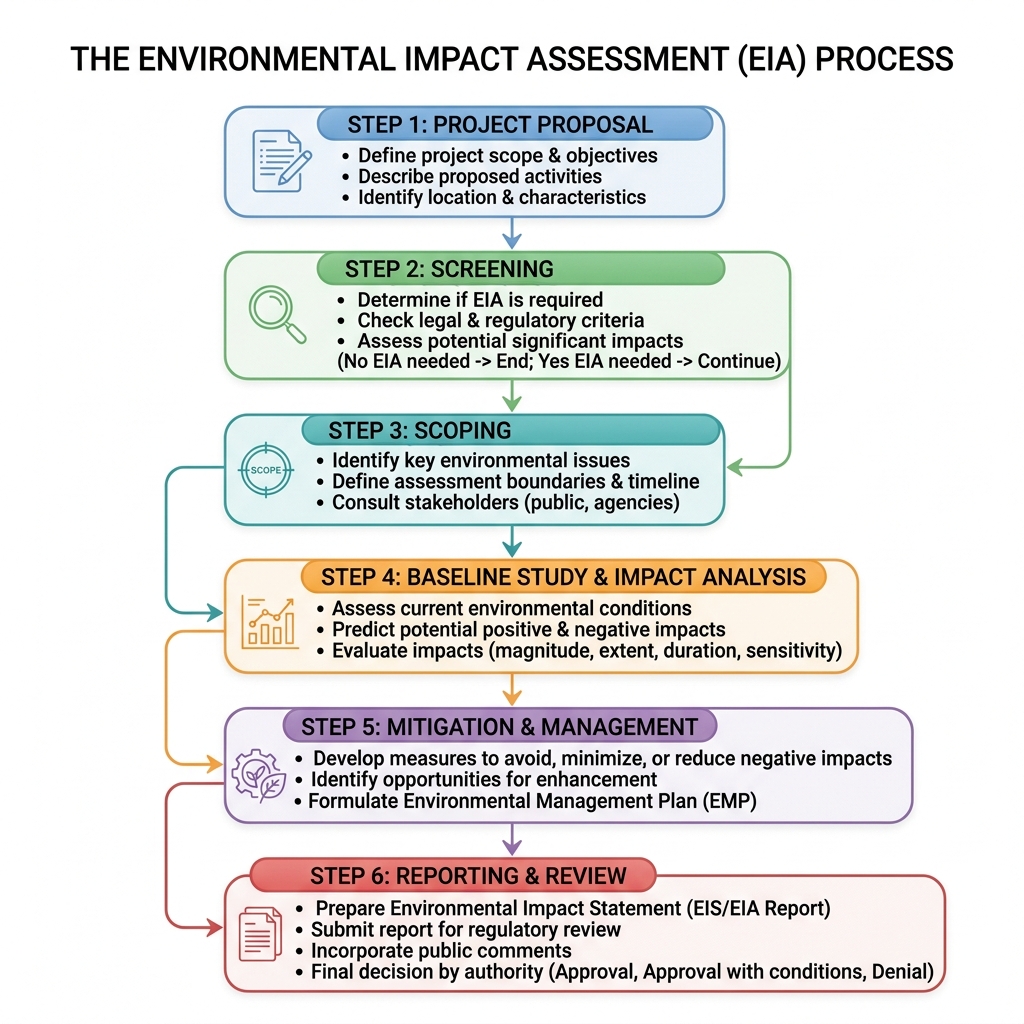
7. Write a brief note about environmental impact assessment using flow chart. What are the objectives of EIA? How it is associated with sustainable development?
Environmental Impact Assessment (EIA):
EIA is a formal process used to predict, evaluate, and mitigate the environmental consequences of a proposed major development project prior to making major decisions and commitments.
Flowchart of EIA Process:
Objectives of EIA:
- To identify and evaluate the potential environmental, social, and economic impacts of a project.
- To propose preventative and mitigation measures to minimize adverse effects.
- To promote public participation and transparency in decision-making.
Association with Sustainable Development:
EIA is the primary practical tool used to achieve sustainable development. By anticipating environmental damage before it happens, EIA ensures that economic development projects do not exhaust natural resources or cause irreversible ecological harm, thereby preserving the environment for future generations.
8. (a) Define the terms: DO, BOD and COD. (b) Discuss the principle of BOD test. (c) Write a brief note about eutrophication.
(a) Definitions:
- DO (Dissolved Oxygen): The amount of gaseous oxygen dissolved in water, crucial for the survival of aquatic organisms.
- BOD (Biochemical Oxygen Demand): The amount of dissolved oxygen consumed by aerobic bacteria to biologically break down organic matter in a water sample over a specific period (usually 5 days at 20°C).
- COD (Chemical Oxygen Demand): The total amount of oxygen required to chemically oxidize all organic and inorganic contaminants in water using a strong chemical oxidizing agent (like potassium dichromate). COD is always higher than BOD.
(b) Principle of the BOD Test:
The BOD test measures the rate of oxygen uptake by microorganisms in a water sample at a controlled temperature (20°C) over 5 days in the dark (to prevent photosynthesis). The principle is based on measuring the initial Dissolved Oxygen (DO₁) of the sample, incubating it for 5 days, and then measuring the final Dissolved Oxygen (DO₅). The difference between these two values represents the amount of oxygen consumed by bacteria to degrade the organic waste.
Formula: BOD = (DO₁ - DO₅) * Dilution Factor.
(c) Eutrophication:
Eutrophication is the process by which a water body becomes overly enriched with nutrients, primarily nitrates and phosphates (often from agricultural fertilizer runoff or untreated sewage). This excessive nutrient load triggers a rapid and massive overgrowth of algae, known as an "algal bloom." When the algae die, bacteria decompose them, consuming vast amounts of dissolved oxygen in the process. This depletion of oxygen creates "dead zones" where fish and other aquatic life cannot survive.
9. Write a brief note about different types of solid waste management.
Solid Waste Management (SWM) involves various techniques depending on the nature of the waste:
- Recycling and Recovery: The process of collecting, sorting, and processing discarded materials (paper, glass, metals, plastics) into new products, reducing the need for raw materials.
- Composting: A biological process where microorganisms break down organic (biodegradable) waste like food scraps and yard trimmings in the presence of oxygen, turning it into nutrient-rich humus (fertilizer).
- Incineration (Waste-to-Energy): The controlled combustion of solid waste at very high temperatures. It reduces waste volume by up to 90% and the heat generated can be used to produce electricity. However, it requires stringent pollution control mechanisms to prevent toxic emissions.
- Sanitary Landfilling: The most common method. Waste is compacted and buried in large, engineered pits lined with impermeable clay or synthetic liners to prevent groundwater contamination (leachate). Daily soil cover is applied to prevent odors and pests. Methane gas recovery systems are often installed.
- Biomethanation: Anaerobic decomposition of organic waste to produce biogas (methane), which can be used as a renewable fuel source.
10. Discuss in details the different types of noise pollution. Describe the adverse effect of noise pollution. Give brief description of hearing mechanism of human beings.
Types of Noise Pollution:
- Transport Noise: The largest contributor, including road traffic (horns, engines), aircraft (jet engines), and railways.
- Industrial Noise: Generated by heavy machinery, generators, exhaust fans, and manufacturing processes inside factories.
- Neighborhood/Community Noise: Loud music, loudspeakers, construction activities, domestic appliances, and barking dogs.
Adverse Effects of Noise Pollution:
- Auditory Effects: Temporary threshold shift (ringing in ears) or permanent Noise-Induced Hearing Loss (NIHL) due to damage to the hair cells in the inner ear.
- Non-Auditory Effects: Sleep deprivation, increased stress hormones, hypertension (high blood pressure), cardiovascular diseases, poor concentration, and psychological issues like irritability and anxiety.
Hearing Mechanism of Human Beings:
The human ear is divided into three parts:
- Outer Ear: The pinna catches sound waves and funnels them down the ear canal to the eardrum (tympanic membrane), making it vibrate.
- Middle Ear: The vibrations are amplified and transmitted by three tiny bones (ossicles: malleus, incus, and stapes).
- Inner Ear: The stapes pushes against the fluid-filled cochlea. The fluid movement bends tiny sensory hair cells inside the cochlea. These hair cells convert the mechanical vibrations into electrical nerve impulses, which travel via the auditory nerve to the brain, where they are interpreted as sound.
11. List three basic elements that might require alteration or modification to solve a noise problem.
To effectively solve a noise problem, acoustic engineering focuses on modifying three basic elements of the noise transmission system:
- The Source (Noise Generation):
Modification involves preventing or reducing the sound before it is radiated. This is the most effective element to alter. Solutions include substituting loud machinery with quieter alternatives, properly lubricating moving parts, installing vibration mounts, using silencers/mufflers on engines, and reducing the operating speed of the equipment.
- The Path (Noise Transmission):
If the source cannot be quieted, the transmission path between the source and the receiver must be altered. Solutions include placing sound-absorbing enclosures around the machinery, installing acoustic barriers or sound walls (common along highways), planting dense trees, and increasing the physical distance between the noise source and people.
- The Receiver (The Person Affected):
If neither the source nor the path can be adequately modified, the receiver must be protected. This involves administrative controls (limiting the time a worker is exposed to the noise), providing Personal Protective Equipment (PPE) like earplugs or earmuffs, and constructing soundproof control rooms or double-glazed windows in residential areas.