Environmental Sciences - 2024
Complete Detailed Solutions · Previous Year Paper
Group A — Very Short Answer Type
1. (I) What are causes of acid rain and what is its effects on natural environment?
Causes: Emissions of sulfur dioxide (SO₂) and nitrogen oxides (NOx) from burning fossil fuels (vehicles, power plants) which react with water vapor in the atmosphere to form sulfuric and nitric acids.
Effects: It lowers the pH of soil and water bodies, harming aquatic life, damaging forests and vegetation, and accelerating the decay of building materials and historical monuments.
1. (II) What do you understand by GCM?
GCM (General Circulation Model or Global Climate Model) is a complex mathematical representation of the major climate system components (atmosphere, land surface, ocean, and sea ice) and their interactions. It is used to simulate global weather and predict future climate changes.
1. (III) What are In-situ and Ex-situ conservation method of biodiversity?
In-situ (on-site) conservation: Protecting an endangered plant or animal species in its natural habitat (e.g., National Parks, Wildlife Sanctuaries).
Ex-situ (off-site) conservation: Protecting species outside their natural habitats in controlled environments (e.g., Zoos, Botanical Gardens, Seed Banks).
1. (IV) Graphically explain the relationship between BOD and DO.
When organic pollution enters a river, Biochemical Oxygen Demand (BOD) spikes as bacteria multiply to consume the waste. As they consume the waste, they deplete the oxygen, causing Dissolved Oxygen (DO) to drop sharply, creating an "oxygen sag curve." As the waste is broken down over time and distance, BOD slowly decreases, allowing DO to recover back to normal levels.
1. (V) What are the various sources of water pollution?
Major sources include: Industrial effluents (heavy metals, chemicals), agricultural runoff (fertilizers, pesticides causing eutrophication), domestic sewage (untreated wastewater), and oil spills.
1. (VI) Mention name of few gases generated from Incineration plant.
Gases typically generated include Carbon Dioxide (CO₂), Water Vapor (H₂O), Carbon Monoxide (CO), Sulfur Dioxide (SO₂), Nitrogen Oxides (NOx), Hydrogen Chloride (HCl), and highly toxic Dioxins and Furans.
1. (VII) Mention various types of noise pollution and its effects on human being.
Types: Transport noise (traffic, aircraft), Industrial noise, Neighborhood noise (loudspeakers, construction).
Effects: Hearing impairment/loss, sleep disturbance, cardiovascular issues (hypertension), stress, and decreased cognitive performance.
1. (VIII) What authorizes the Central Government of India in Environmental Protection Act, 1986?
The Act authorizes the Central Government to take all necessary measures to protect and improve the quality of the environment, establish environmental standards, regulate industrial locations, and lay down procedures/safeguards for handling hazardous substances.
1. (IX) What are the various types of earthquake waves generated in the earth surface?
There are two main types: Body Waves (P-waves or Primary waves which are fast compressional waves, and S-waves or Secondary waves which are slower shear waves) and Surface Waves (Love waves and Rayleigh waves) which travel along the Earth's surface and cause the most damage.
1. (X) Mention the types and function of various components of ecosystem.
Abiotic Components: Physical factors (sunlight, soil, water) that provide the foundation and nutrients.
Biotic Components: Producers (make food), Consumers (eat others for energy), and Decomposers (break down dead matter, recycling nutrients back into the ecosystem).
1. (XI) Mention the various elements of air pollution as per NAAQS.
The National Ambient Air Quality Standards (NAAQS) primarily monitor: Particulate Matter (PM10 and PM2.5), Sulfur Dioxide (SO₂), Nitrogen Dioxide (NO₂), Carbon Monoxide (CO), Ozone (O₃), Lead (Pb), Ammonia (NH₃), and Benzene.
1. (XII) What is meant by 5-day BOD and Ultimate BOD?
5-day BOD (BOD₅): The amount of dissolved oxygen consumed by microorganisms to decompose organic matter over a standard 5-day period at 20°C.
Ultimate BOD (BODᵤ): The total amount of oxygen required for the complete microbial breakdown of organic matter in a water sample over an infinite period.
Group B — Short Answer Type
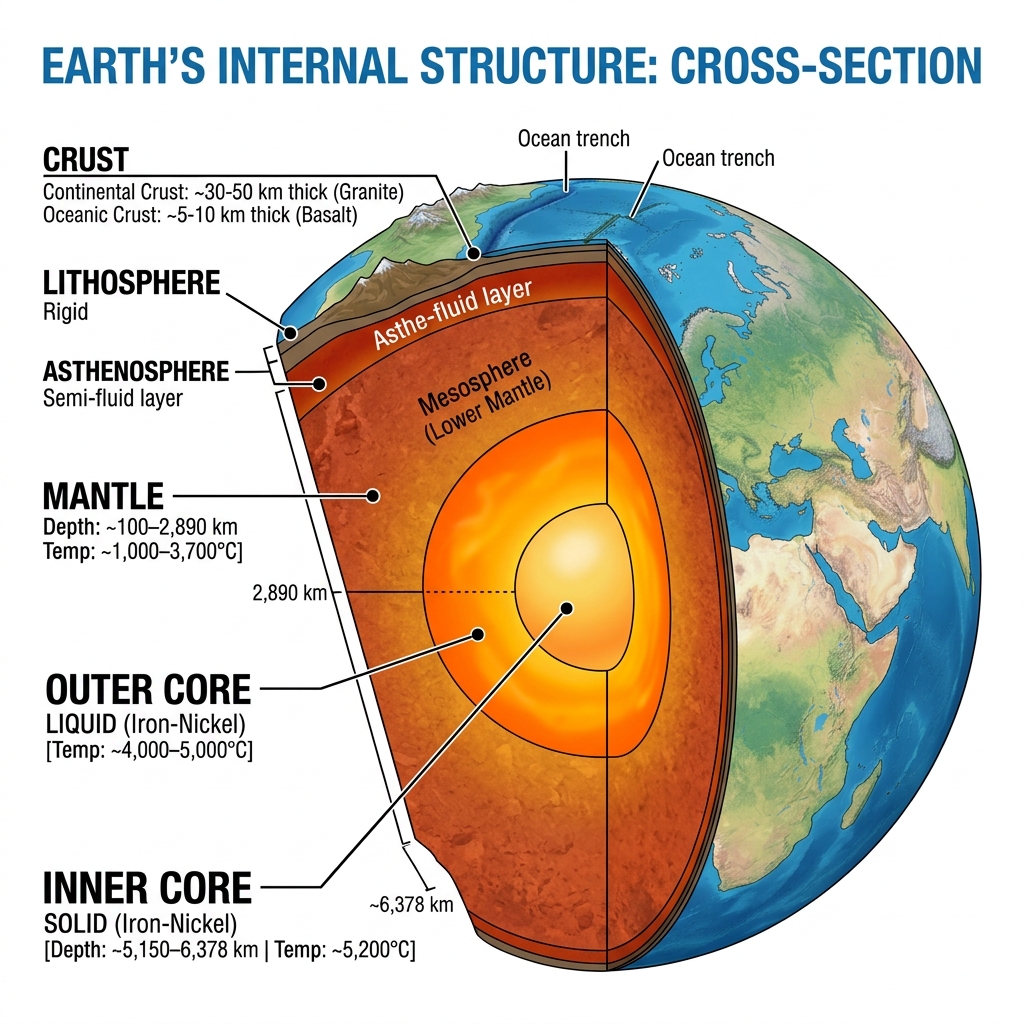
2. (i) Explain with neat diagram the internal structure of the Earth. (ii) What do you mean by rock cycle?
(i) Internal Structure of the Earth:
The Earth is composed of three main concentric layers:
- Crust: The outermost solid shell. It is very thin (5-70 km) and is divided into continental crust (thicker, granitic) and oceanic crust (thinner, basaltic).
- Mantle: The thickest layer (about 2,900 km). It is made of hot, semi-solid rock. Convection currents in the mantle drive tectonic plate movement.
- Core: The center of the Earth, mainly composed of iron and nickel. It has two parts: the liquid Outer Core (creates Earth's magnetic field) and the solid Inner Core (extremely hot but solid due to immense pressure).
Diagrammatic Representation:
(ii) Rock Cycle:
The Rock Cycle is a continuous, geological process by which rocks are created, changed from one form to another, and destroyed over millions of years. The three main rock types are Igneous, Sedimentary, and Metamorphic.
- Magma cools to form Igneous rock.
- Weathering breaks rocks into sediments, which compact to form Sedimentary rock.
- Heat and pressure transform igneous or sedimentary rocks into Metamorphic rock.
- Metamorphic rocks can melt back into magma, restarting the cycle.
3. (i) What do you mean by maximum mixing depth? (ii) Differentiate between Ambient lapse rate and Adiabatic lapse rate.
(i) Maximum Mixing Depth (MMD):
Maximum Mixing Depth refers to the maximum vertical height or thickness of the atmospheric layer near the ground within which air pollutants and heat can be vigorously mixed and dispersed by convection and turbulence. A higher mixing depth means better dispersion of pollutants, leading to better air quality.
(ii) Difference between Ambient Lapse Rate and Adiabatic Lapse Rate:
| Feature | Ambient (Environmental) Lapse Rate (ALR) | Adiabatic Lapse Rate |
|---|---|---|
| Definition | The actual, measured rate at which the air temperature changes with altitude at a specific time and place. | The theoretical rate at which a parcel of air cools or warms as it moves vertically, without exchanging heat with its surroundings. |
| Value | Highly variable depending on weather, time of day, and location. Average is ~6.5°C per km. | Constant for a given state: Dry Adiabatic Lapse Rate (DALR) is ~9.8°C/km. Wet/Saturated (SALR) is ~5-6°C/km. |
| Purpose | Describes the state of the surrounding atmosphere. | Describes what happens to a specific moving parcel of air. (Comparing ALR to Adiabatic determines atmospheric stability). |
4. (i) Define flood and how can it be mitigated and controlled? (ii) What do you understand by anthropogenic environmental degradation?
(i) Flood and Mitigation:
A flood is an overflow of water onto land that is normally dry. It often happens during heavy rainfall, rapid snowmelt, or when a river bursts its banks or a dam fails.
Control and Mitigation:
- Structural Measures: Building dams, reservoirs, levees, and embankments to contain excess water. Improving drainage systems and desilting riverbeds to increase carrying capacity.
- Non-Structural Measures: Reforestation in catchment areas (roots absorb water and reduce runoff), flood plain zoning (restricting construction in vulnerable areas), and establishing early warning systems for evacuation.
(ii) Anthropogenic Environmental Degradation:
This refers to the deterioration of the environment (air, water, soil, ecosystems) caused specifically by human activities. Unlike natural degradation (like volcanic eruptions), anthropogenic degradation includes deforestation, industrial pollution, over-mining, carbon emissions causing global warming, and plastic waste accumulation. It disrupts ecological balance and threatens biodiversity.
5. (i) Write the equation for population growth and explain the notations. (ii) How to calculate "Natural Increase Rate"?
(i) Population Growth Equation:
The standard equation for population growth over a given time period is:
P(t) = P(0) + (B - D) + (I - E)
Notations:
- P(t): Population at time t (future/current population).
- P(0): Initial population at the starting time.
- B: Number of Births during the period.
- D: Number of Deaths during the period.
- I: Immigration (number of people moving into the area).
- E: Emigration (number of people moving out of the area).
(ii) Natural Increase Rate (NIR):
The Natural Increase Rate measures the growth of a population excluding migration. It is calculated by subtracting the crude death rate from the crude birth rate.
Formula: NIR = (Crude Birth Rate - Crude Death Rate) / 10
Note: The rate is typically expressed as a percentage. Crude rates are usually given per 1,000 people, hence the division by 10 to get a percentage.
6. (i) How arsenic get dissolved in groundwater in the aquifer system? (iii) How many districts in West Bengal are exposed to groundwater arsenic contamination?
(i) Dissolution of Arsenic in Groundwater:
Arsenic contamination in groundwater is primarily a natural, geological phenomenon. The arsenic is naturally present in the aquifer sediments, often bound to iron oxide or hydroxide minerals.
Under specific geochemical conditions—such as highly reducing (anaerobic) conditions often caused by the decomposition of buried organic matter—the iron oxides dissolve. When the iron minerals break down, the arsenic bound to them is released and mobilized, dissolving into the groundwater.
(iii) Affected Districts in West Bengal:
West Bengal is one of the most severely affected regions globally. Out of 23 districts in West Bengal, currently 9 to 12 districts (depending on recent surveys) are highly exposed to severe groundwater arsenic contamination (levels above the WHO guideline of 10 ppb). Severely affected districts include Malda, Murshidabad, Nadia, North 24 Parganas, and South 24 Parganas.
Group C — Long Answer Type
7. (i) What are different types of solid wastes? (ii) What are the methods of solid waste disposal and management? (iii) What are the advantages and disadvantages of Land filling of solid waste?
(i) Types of Solid Waste:
- Municipal Solid Waste (MSW): Household garbage, paper, plastics, food waste.
- Industrial Waste: Scrap metal, chemicals, ash from factories.
- Biomedical/Hospital Waste: Syringes, bandages, anatomical waste (highly infectious).
- E-Waste (Electronic Waste): Discarded computers, phones, batteries (contains heavy metals).
- Agricultural Waste: Crop residues, animal manure.
(ii) Methods of Solid Waste Disposal and Management:
- Source Reduction & Recycling: The most preferred method. Reducing waste generation and reusing materials.
- Composting: Biological decomposition of organic waste into nutrient-rich fertilizer.
- Incineration: Burning waste at very high temperatures. Reduces volume significantly and can generate electricity, but requires expensive air pollution controls.
- Sanitary Landfilling: Disposing of waste in engineered pits lined with clay/plastic to prevent soil and water contamination.
(iii) Landfilling - Advantages and Disadvantages:
Advantages:
- Relatively inexpensive and simple compared to incineration.
- Can handle vast quantities and all types of solid waste.
- Methane gas generated during decomposition can be captured and used as fuel.
Disadvantages:
- Requires large areas of land, which is scarce in urban areas.
- Risk of leachate (toxic liquid) leaking and contaminating groundwater if linings fail.
- Releases methane (a potent greenhouse gas) if not properly captured.
- Creates odor, attracts pests, and lowers local property values.
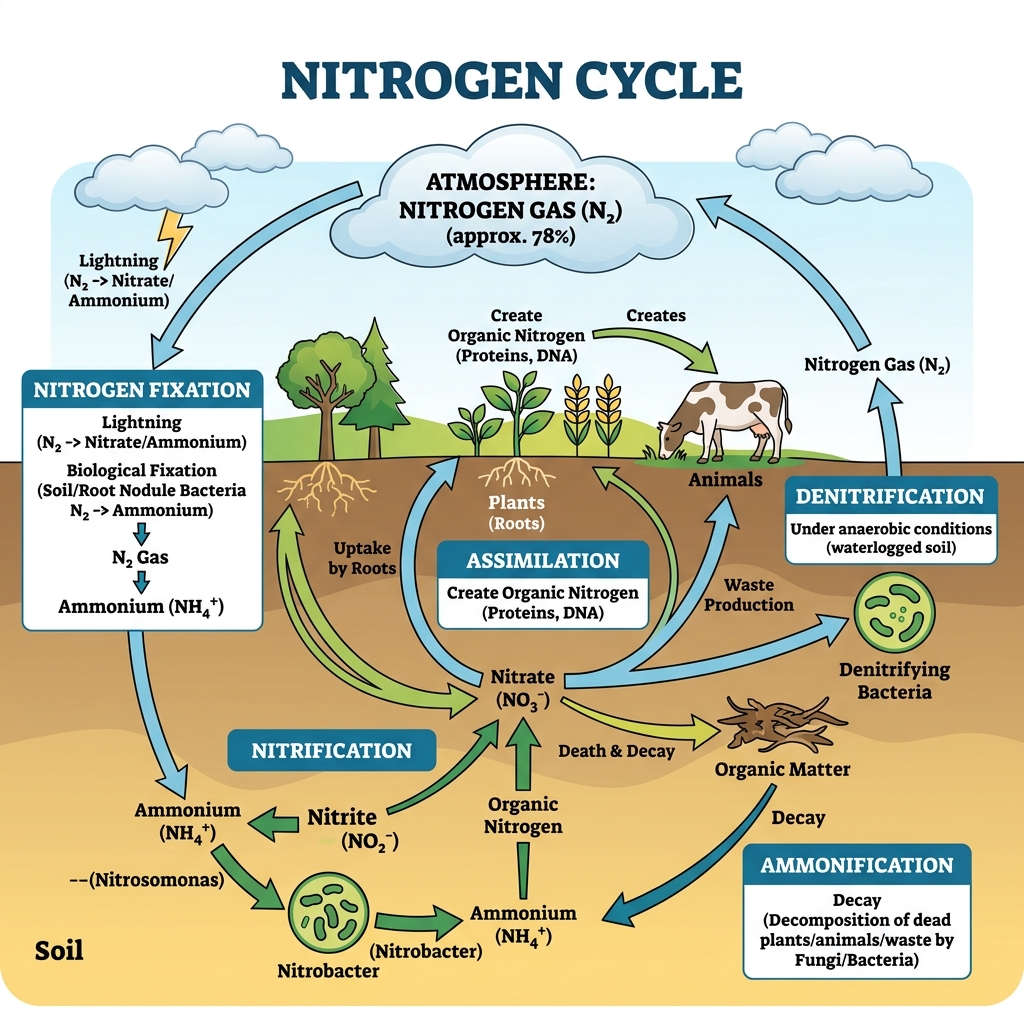
8. (i) What are Nutrient cycles and how are they important for our environment? (ii) Draw a flowchart for Nitrogen Cycle. (ii) Explain Biogeochemical cycle by a diagram.
(i) Nutrient Cycles & Their Importance:
Nutrient cycles (or biogeochemical cycles) are the natural pathways by which essential elements of living matter (like Carbon, Nitrogen, Phosphorus, Oxygen) are circulated from the abiotic environment (air, water, soil) into the biotic environment (living organisms) and back again.
Importance: They ensure that vital elements are never permanently lost but continuously recycled. Without these cycles, ecosystems would quickly deplete their nutrients, and life on Earth would cease to exist. They maintain ecological balance and regulate the climate.
(ii) Nitrogen Cycle Flowchart:
(ii) Biogeochemical Cycle Concept Diagram:
A generalized biogeochemical cycle involves the flow between the primary "spheres" of Earth:
      +------------------+
      |  Atmosphere      | (Air/Gases)
      +------------------+
        ^              |
        |              | (Precipitation, Absorption)
  (Evaporation,        v
   Respiration)  +------------------+
                 |   Biosphere      | (Living Organisms)
                 +------------------+
        ^              |
        |              | (Decomposition, Sedimentation)
(Uptake by roots)      v
      +------------------+
      | Lithosphere /    | (Soil, Rocks, Water)
      | Hydrosphere      |
      +------------------+
9. (i) Mention various types of greenhouse gases and its effects on terrestrial ecosystems. (ii) How global warming and climate change are related? (iii) What is short wave and long wave radiation?
(i) Greenhouse Gases & Effects on Terrestrial Ecosystems:
Gases: Carbon Dioxide (CO₂), Methane (CH₄), Nitrous Oxide (N₂O), Chlorofluorocarbons (CFCs), and Water Vapor.
Effects on Terrestrial Ecosystems: Increased temperatures alter growing seasons, forcing flora and fauna to migrate towards higher altitudes or latitudes. It causes increased frequency of forest fires, shifts in vegetation zones (e.g., deserts expanding), and disrupts synchronized ecological events (like flowering and pollination).
(ii) Relationship between Global Warming and Climate Change:
While often used interchangeably, they are distinct. Global Warming refers specifically to the long-term heating of Earth's surface due to human-emitted greenhouse gases. Climate Change is a broader term; it includes global warming but also encompasses all the side effects of that warming—such as melting glaciers, heavier rainstorms, more frequent drought, and shifting weather patterns. Global warming is the cause; climate change is the effect.
(iii) Short wave and Long wave radiation:
- Short Wave Radiation: This is the energy emitted by the Sun. Because the Sun is extremely hot, it emits energy in short wavelengths (primarily visible light and ultraviolet). This radiation easily passes through the Earth's atmosphere.
- Long Wave Radiation: This is the energy re-emitted by the Earth. Because the Earth is much cooler than the Sun, it absorbs the shortwave energy and radiates it back into space as heat (infrared radiation) in longer wavelengths. Greenhouse gases are opaque to this long wave radiation, trapping it and causing the greenhouse effect.
10. (i) Why sustainable growth is considered modern concept of development? (ii) How population growth in India can be controlled? (iii) If the present population of the World is 8.00 billion, what would be the population of the World after 25 years with a growth rate of 1% per year?
(i) Sustainable Growth as a Modern Concept:
Historically, "development" was measured purely by economic growth (GDP, industrialization), often ignoring environmental destruction and social inequality. Sustainable growth is the modern concept because it introduces a holistic paradigm: development must balance economic progress with environmental conservation and social equity, ensuring that current progress does not ruin the resources future generations will need.
(ii) Controlling Population Growth in India:
- Education and Empowerment: Educating women significantly delays the age of marriage and increases awareness of family planning, directly lowering fertility rates.
- Access to Contraceptives: Widespread distribution and education regarding modern family planning methods.
- Economic Development: As standard of living increases, families traditionally choose to have fewer children (Demographic Transition).
- Healthcare Improvements: Lowering infant mortality rates reassures parents that their children will survive, reducing the desire for large families.
(iii) Population Math Problem:
We use the exponential growth formula: P(t) = P(0) * (1 + r)^t
- P(0) = Initial Population = 8.00 billion
- r = Growth rate = 1% = 0.01
- t = Time = 25 years
P(25) = 8.00 * (1 + 0.01)^25
P(25) = 8.00 * (1.01)^25
P(25) = 8.00 * 1.2824
P(25) ≈ 10.26 billion
The population after 25 years would be approximately 10.26 billion.
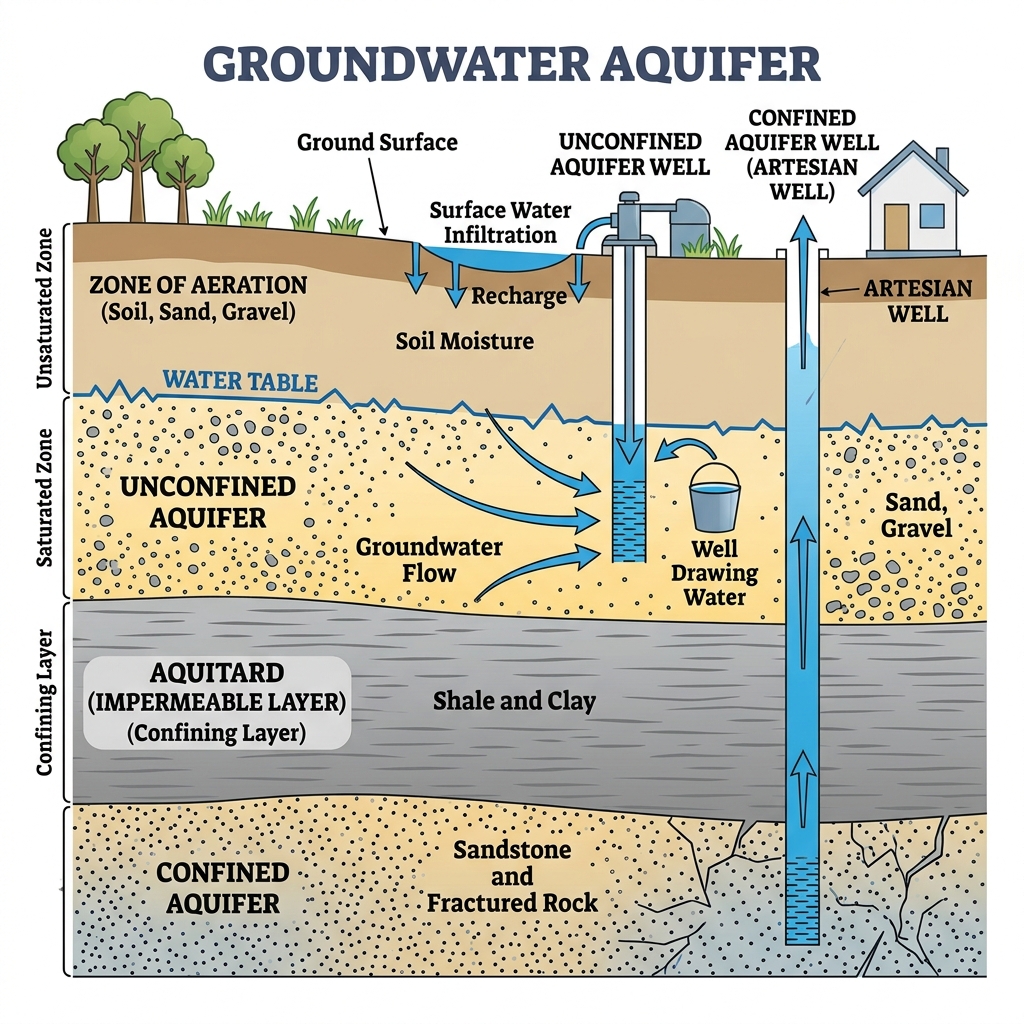
11. (i) What is a groundwater aquifer, aquiclude and aquitard. Explain with neat diagram. (ii) How groundwater is recharged? (iv) What do you understand by Rooftop rainwater harvesting?
(i) Groundwater Terms:
- Aquifer: A highly permeable geological formation (like sand or gravel) that contains and transmits economically significant quantities of groundwater.
- Aquiclude: An impermeable geological formation (like solid clay) that may contain water but does not transmit it; it acts as a barrier to groundwater flow.
- Aquitard: A semi-permeable formation (like sandy clay) that stores water and transmits it very slowly from one aquifer to another.
Diagrammatic Representation:
(ii) Groundwater Recharge:
Groundwater is recharged naturally when rain and snowmelt seep down through the soil and rock layers into the aquifers (infiltration and percolation). It can also be recharged artificially by redirecting surface water into recharge basins, trenches, or injection wells to replenish depleted aquifers.
(iv) Rooftop Rainwater Harvesting:
Rooftop rainwater harvesting is the technique of capturing and storing rainwater directly from the roof of a house or building. Gutters and pipes channel the rainwater into a storage tank (for immediate domestic use) or direct it into a recharge pit (to replenish the local groundwater aquifer). This practice is highly effective in conserving water, reducing urban flooding, and mitigating the depletion of groundwater.