Environmental Sciences - 2023
Complete Detailed Solutions · Previous Year Paper
Group A — Very Short Answer Type
1. (I) What do you mean by Abiotic component of ecosystem?
Abiotic components are the non-living chemical and physical parts of the environment that affect living organisms and the functioning of ecosystems. These include factors like sunlight, temperature, wind, water, soil, atmospheric gases, and minerals.
1. (II) Define the term Lithosphere.
The Lithosphere is the solid, outer part of the Earth. It includes the brittle upper portion of the mantle and the crust, serving as the foundation for terrestrial ecosystems and providing essential minerals to living organisms.
1. (III) Define the term hydrosphere.
The Hydrosphere is the combined mass of water found on, under, and above the surface of a planet. It encompasses all oceans, lakes, rivers, groundwater, atmospheric water vapor, and glaciers.
1. (IV) What do you mean by soil pollution?
Soil pollution (or soil contamination) refers to the presence of toxic chemicals, pollutants, or contaminants in the soil in high enough concentrations to pose a risk to human health and the ecosystem, often resulting from industrial activity, agricultural chemicals, or improper waste disposal.
1. (V) What is the unit of measurement of sound?
The primary unit of measurement for sound level or intensity is the Decibel (dB).
1. (VI) The Environment (Protection) Act was enacted in which year?
The Environment (Protection) Act was enacted in India in the year 1986.
1. (VII) What do you mean by anthropogenic waste?
Anthropogenic waste refers to waste and pollutants generated specifically by human activities, such as industrial emissions, household garbage, agricultural runoff, and plastic waste, as opposed to naturally occurring waste.
1. (VIII) What are the major types of ecosystem?
The major types of ecosystems are broadly categorized into Terrestrial Ecosystems (forest, grassland, desert, tundra) and Aquatic Ecosystems (freshwater like lakes/rivers, and marine like oceans/coral reefs).
1. (IX) What is greenhouse effect?
The greenhouse effect is the natural process by which certain gases in the Earth's atmosphere (like CO₂, methane, and water vapor) trap heat from the sun, preventing it from escaping back into space and thereby warming the planet to sustain life.
1. (X) Define the term COD.
COD (Chemical Oxygen Demand) is a measure of the total amount of oxygen required to chemically oxidize all organic and inorganic reactive substances in a water sample. It is a vital metric for determining the amount of pollution in water.
1. (XI) What is acid rain?
Acid rain is any form of precipitation (rain, snow, fog) that is unusually acidic (has an elevated level of hydrogen ions, low pH). It is primarily caused by emissions of sulfur dioxide (SO₂) and nitrogen oxides (NOx) reacting with water molecules in the atmosphere.
1. (XII) Who developed the concept of ecological pyramid?
The concept of the ecological pyramid was first developed by the British ecologist Charles Elton in 1927, which is why it is also often referred to as an Eltonian pyramid.
Group B — Short Answer Type
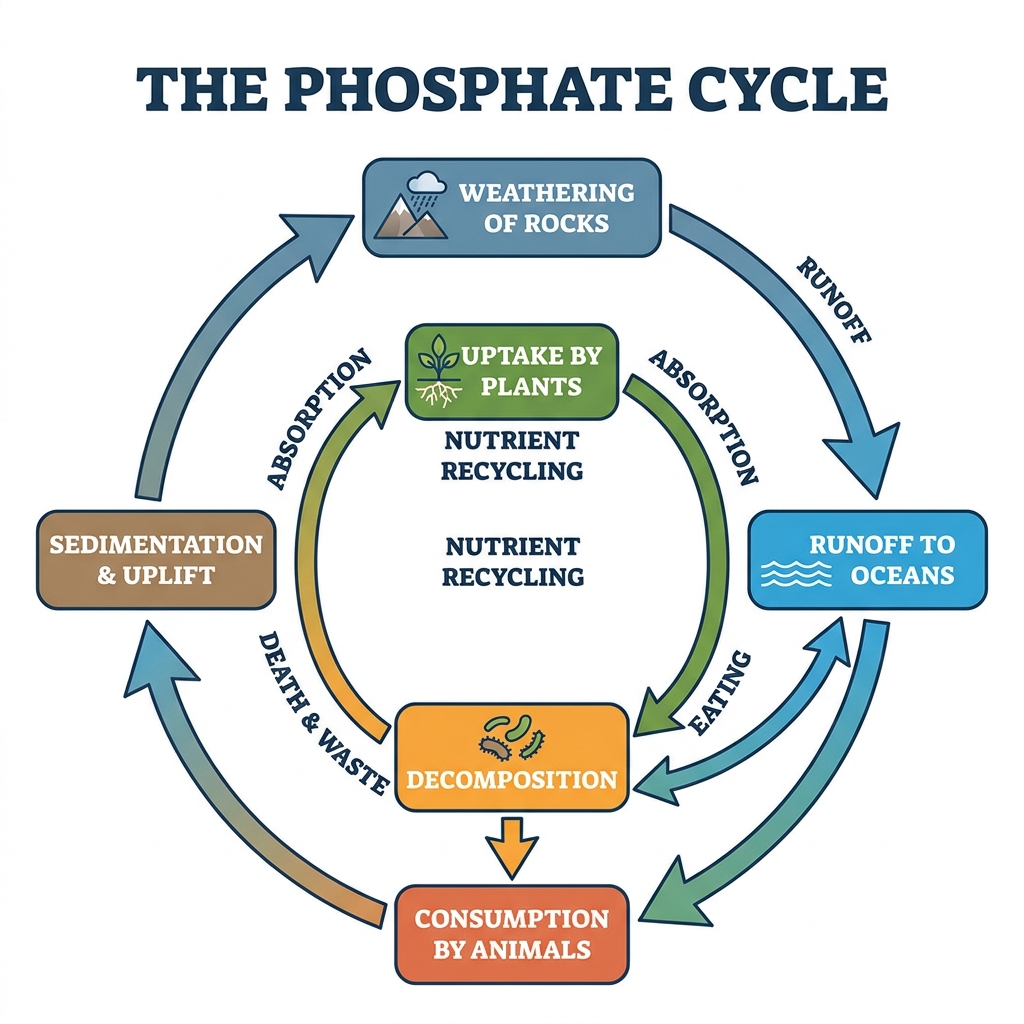
2. Discuss about the phosphate cycle with diagram.
The Phosphorus Cycle (Phosphate Cycle) is the biogeochemical process by which phosphorus moves through the lithosphere, hydrosphere, and biosphere. Unlike the carbon or nitrogen cycles, it does not involve the atmosphere significantly, as phosphorus is primarily found in solid rocks and soil minerals.
- Weathering: Phosphorus is found in rocks. Over time, rain and weathering cause rocks to release phosphate ions and other minerals into soils and water.
- Absorption by Plants: Plants take up inorganic phosphate from the soil.
- Consumption by Animals: Animals obtain phosphorus by eating plants or plant-eating animals.
- Decomposition: When plants and animals die, bacteria decompose their bodies, returning phosphorus to the soil.
- Sedimentation: Phosphorus in soil can wash into waterways, eventually settling at the bottom as sediment, turning back into rock over millions of years.
Flowchart Representation:
3. Write a short note about green house effect.
The Greenhouse Effect is a natural phenomenon crucial for keeping the Earth warm enough to sustain life.
Mechanism: Solar radiation passes through the atmosphere and warms the Earth's surface. The Earth then radiates heat back outward as infrared radiation. Certain gases in the atmosphere, known as greenhouse gases (GHGs), absorb a portion of this outgoing infrared radiation, trapping heat and radiating it back to the surface.
Major Greenhouse Gases:
- Carbon Dioxide (CO₂): From fossil fuels and deforestation.
- Methane (CH₄): From agriculture and livestock.
- Nitrous Oxide (N₂O): From fertilizers.
- Water Vapor (H₂O) & CFCs.
Impact: While the natural greenhouse effect is beneficial, human activities have artificially amplified it by increasing GHG concentrations. This enhanced greenhouse effect is the primary driver of global warming and rapid climate change.
4. Write a short note about different types of human environment interaction.
Human-Environment Interaction studies how humans adapt to, depend on, and modify their natural surroundings. The three primary types of interaction are:
- Adaptation to the Environment: Humans change their behavior or lifestyle to survive in specific environmental conditions. Example: Wearing heavy woolen clothes in cold climates, or building stilt houses in flood-prone areas.
- Dependence on the Environment: Humans rely entirely on the environment for basic survival needs. Example: Utilizing rivers for drinking water and irrigation, or relying on fertile soil for agriculture.
- Modification of the Environment: Humans actively change the physical environment to suit their needs, often permanently. Example: Deforestation for urban expansion, building dams for hydroelectricity, and mining for minerals. (This type often leads to negative consequences like pollution and habitat loss if not managed sustainably).
5. Write a brief note about ecological pyramid.
An Ecological Pyramid is a graphical representation designed to show the biomass, bioproductivity, or energy flow at each trophic level in a given ecosystem.
Types of Ecological Pyramids:
- Pyramid of Numbers: Represents the number of individual organisms at each trophic level. It can be upright (grassland) or inverted (a single large tree supporting many parasites).
- Pyramid of Biomass: Represents the total amount of living tissue (dry weight) within a given trophic level. It is usually upright in terrestrial ecosystems but can be inverted in aquatic ecosystems (where phytoplankton have lower biomass but rapid turnover compared to zooplankton).
- Pyramid of Energy: Represents the amount of energy flow from one trophic level to the next. According to the 10% rule, only about 10% of energy is transferred to the next level. This pyramid is ALWAYS upright because energy is inevitably lost as heat during transfer.
6. Write a brief note about standard control and measures for the control of air pollution.
Controlling air pollution requires a combination of technological, regulatory, and personal measures:
1. Technological Measures (At the Source):
- Electrostatic Precipitators (ESPs) & Baghouses: Used in factories and power plants to filter out particulate matter (PM) from exhaust gases.
- Scrubbers: Used to neutralize and remove acidic gases like Sulfur Dioxide (SO₂) from industrial smokestacks.
- Catalytic Converters: Installed in vehicle exhausts to convert harmful CO, NOx, and hydrocarbons into harmless CO₂, water, and nitrogen.
2. Regulatory Measures:
- Enforcing strict National Ambient Air Quality Standards (NAAQS).
- Transitioning to cleaner fuels (e.g., CNG, low-sulfur diesel) and promoting renewable energy (solar, wind).
- Implementing the "Polluter Pays" principle and carbon taxes.
3. Biological & Personal Measures:
- Afforestation: Planting trees creating "green belts" to naturally absorb CO₂ and filter dust.
- Using public transportation, carpooling, and adopting electric vehicles (EVs).
Group C — Long Answer Type
7. (a) What do you mean by Ecosystem? (b) What are the component of Ecosystem? (c) Write down the oxygen cycle with diagram.
(a) Ecosystem: An ecosystem is a geographic area where plants, animals, and other organisms, as well as weather and landscape, work together to form a bubble of life. It is the basic functional unit of ecology, emphasizing the interaction between living organisms (biotic) and their physical environment (abiotic).
(b) Components of Ecosystem:
- Abiotic Components (Non-living): Climatic factors (sunlight, temperature, rain), Edaphic factors (soil structure, minerals), and inorganic substances (water, carbon, nitrogen).
- Biotic Components (Living):
- Producers (Autotrophs): Plants and algae that make their own food via photosynthesis.
- Consumers (Heterotrophs): Animals that eat producers (herbivores) or other animals (carnivores).
- Decomposers (Saprotrophs): Fungi and bacteria that break down dead organic matter, recycling nutrients.
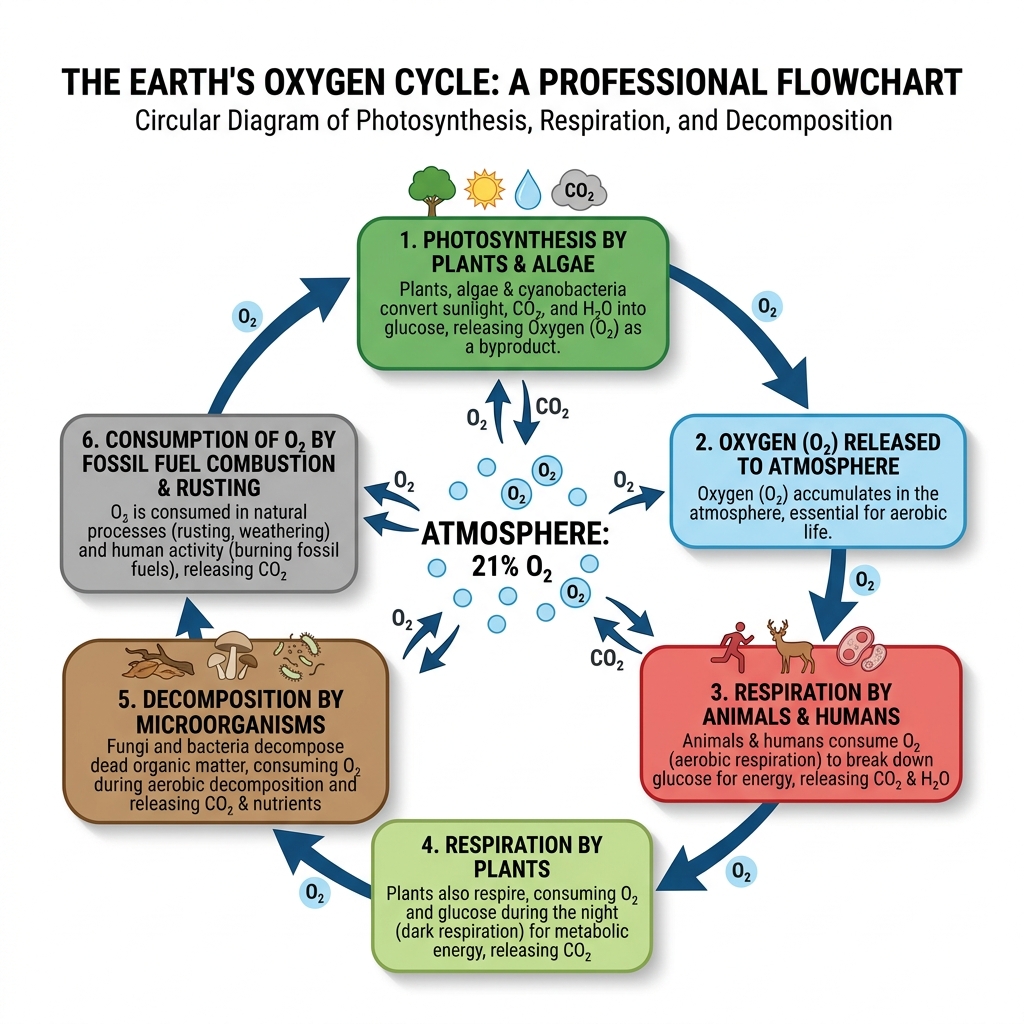
(c) Oxygen Cycle: The oxygen cycle is the biogeochemical cycle of oxygen within its three main reservoirs: the atmosphere, the biosphere, and the lithosphere.
- Photosynthesis (Source): Plants and phytoplankton release oxygen into the atmosphere as a byproduct of producing glucose.
- Respiration (Sink): All aerobic organisms (including plants and animals) inhale oxygen to break down glucose for energy, releasing CO₂ back into the atmosphere.
- Combustion & Decay (Sinks): Burning of fossil fuels and the decomposition of organic matter also consume significant amounts of oxygen.
Flowchart Diagram:
8. (a) What is global warming? (b) How do greenhouse gases cause global warming? (c) What are the adverse effects of global warming?
(a) Global Warming: It refers to the long-term, continuous rise in the average temperature of the Earth's climate system, primarily driven by human activities, especially the emission of greenhouse gases since the pre-industrial period.
(b) How Greenhouse Gases cause Global Warming:
The sun emits shortwave radiation that passes easily through the Earth's atmosphere and warms the surface. The warmed Earth radiates this energy back out as longwave (infrared) thermal radiation. Greenhouse gases (like CO₂, Methane, and N₂O) are largely transparent to shortwave sunlight but highly opaque to longwave infrared radiation. These gases absorb the outgoing infrared radiation and re-radiate it in all directions, including back toward the surface. By artificially increasing the concentration of these gases through burning fossil fuels and deforestation, humans have thickened this "thermal blanket," trapping excess heat and causing the global temperature to rise.
(c) Adverse Effects of Global Warming:
- Melting of Ice Caps and Glaciers: Leading to loss of freshwater reserves and habitat destruction for polar species.
- Sea Level Rise: Expanding ocean water and melting ice cause sea levels to rise, threatening coastal cities and island nations with flooding and submergence.
- Extreme Weather Events: Increased frequency and severity of hurricanes, heatwaves, droughts, and heavy precipitation.
- Biodiversity Loss: Rapid climate shifts alter habitats faster than species can adapt, leading to mass extinctions and coral bleaching.
- Agricultural Disruption: Changes in rainfall patterns and extreme heat reduce crop yields, threatening global food security.
9. a. Write a brief note about sustainable development. b. Define the terms: Total Fertility Rate, Total Mortality Rate, and Age Pyramid.
(a) Sustainable Development:
Sustainable development is defined as "development that meets the needs of the present without compromising the ability of future generations to meet their own needs." It aims to achieve a balance between economic growth, environmental protection, and social equity. Key principles include minimizing the depletion of non-renewable resources, utilizing renewable resources within their capacity for regeneration, preventing pollution, and ensuring fair distribution of resources among all people.
(b) Definitions:
- Total Fertility Rate (TFR): The average number of children that would be born alive to a woman during her lifetime if she were to pass through her childbearing years (15-49) conforming to the age-specific fertility rates of a given year. A TFR of 2.1 is generally considered the "replacement rate" for a population to remain stable.
- Total Mortality Rate (Death Rate): The number of deaths occurring in a given population during a specific time period, typically expressed as the number of deaths per 1,000 individuals per year.
- Age Pyramid (Population Pyramid): A graphical illustration that shows the distribution of various age groups (cohorts) in a population, typically split by gender. The shape of the pyramid (e.g., expansive/broad base, constrictive/narrow base, or stationary) indicates whether the population is growing, shrinking, or stable.
10. (a) What is biogeochemical cycle? (b) Discuss about the carbon and nitrogen cycle with diagram.
(a) Biogeochemical Cycle:
A biogeochemical cycle is the pathway by which a chemical substance cycles the biotic and the abiotic compartments of Earth. "Bio" refers to living organisms, "geo" refers to rocks, soil, air, and water, and "chemical" implies the chemical processes involved. These cycles ensure that essential elements like Carbon, Nitrogen, and Phosphorus are continuously recycled in nature.
(b) Carbon Cycle: The movement of carbon through the biosphere, atmosphere, oceans, and geosphere.
- Atmosphere to Biosphere: Plants absorb CO₂ during photosynthesis to create glucose.
- Biosphere to Atmosphere: Animals and plants release CO₂ through respiration.
- Decomposition: Dead organisms decompose, releasing carbon into the soil and atmosphere. Over millions of years, buried matter forms fossil fuels.
- Human Impact: Burning fossil fuels releases massive amounts of stored carbon back into the atmosphere as CO₂.
Nitrogen Cycle: The complex process of nitrogen conversion.
- Nitrogen Fixation: Atmospheric N₂ (unusable by plants) is converted to ammonia (NH₃) by specialized soil bacteria (e.g., Rhizobium) or lightning.
- Nitrification: Ammonia is converted into nitrites (NO₂⁻) and then nitrates (NO₃⁻) by nitrifying bacteria. Nitrates are easily absorbed by plants.
- Assimilation: Plants incorporate nitrates into proteins; animals eat plants to get nitrogen.
- Ammonification: Decomposers convert nitrogenous waste and dead tissue back into ammonia.
- Denitrification: Denitrifying bacteria convert soil nitrates back into atmospheric N₂ gas, completing the cycle.
(Flowchart representations can be drawn showing these distinct steps flowing in a cycle).
11. What is dissolve oxygen? What is its importance as water quality parameter?
Dissolved Oxygen (DO):
Dissolved Oxygen refers to the level of free, non-compound oxygen present in water or other liquids. It is an important parameter in assessing water quality because of its influence on the organisms living within a body of water. Oxygen enters the water through direct absorption from the atmosphere, rapid movement (like in rapids or waterfalls), and as a byproduct of underwater plant photosynthesis.
Importance as a Water Quality Parameter:
- Survival of Aquatic Life: DO is absolutely critical for the survival of most aquatic organisms, including fish, invertebrates, and aerobic bacteria. Different species have different DO requirements; for example, trout require high DO levels, while catfish can survive in lower levels. If DO drops too low (hypoxia) or reaches zero (anoxia), massive fish kills can occur.
- Indicator of Pollution: High levels of organic pollution (like sewage or agricultural runoff) lead to an explosion of aerobic bacteria that consume the organic matter. Because these bacteria consume oxygen during this decomposition process, a sharp drop in DO is a primary indicator of severe organic water pollution.
- Aesthetic and Odor Issues: When DO levels are completely depleted (anoxic conditions), anaerobic bacteria take over decomposition. This process releases toxic and foul-smelling gases like hydrogen sulfide (smells like rotten eggs) and methane, drastically degrading the water quality aesthetically.
- Chemical Stability: Adequate DO prevents the release of heavy metals and phosphorus from the sediment into the water column. When DO is absent, chemical reactions at the bottom of the water body change, which can release stored toxins back into the water.
Generally, a DO level of 5-6 ppm (parts per million) is required for diverse aquatic life, while levels below 3 ppm are stressful to most aquatic organisms.